The Cocoon Nebula, an Analemma over Scotland, and Typhoon Dujuan
A comet-like stellar nursery thousands of light-years away, a yearlong solar path over Scotland, and an active tropical cyclone.
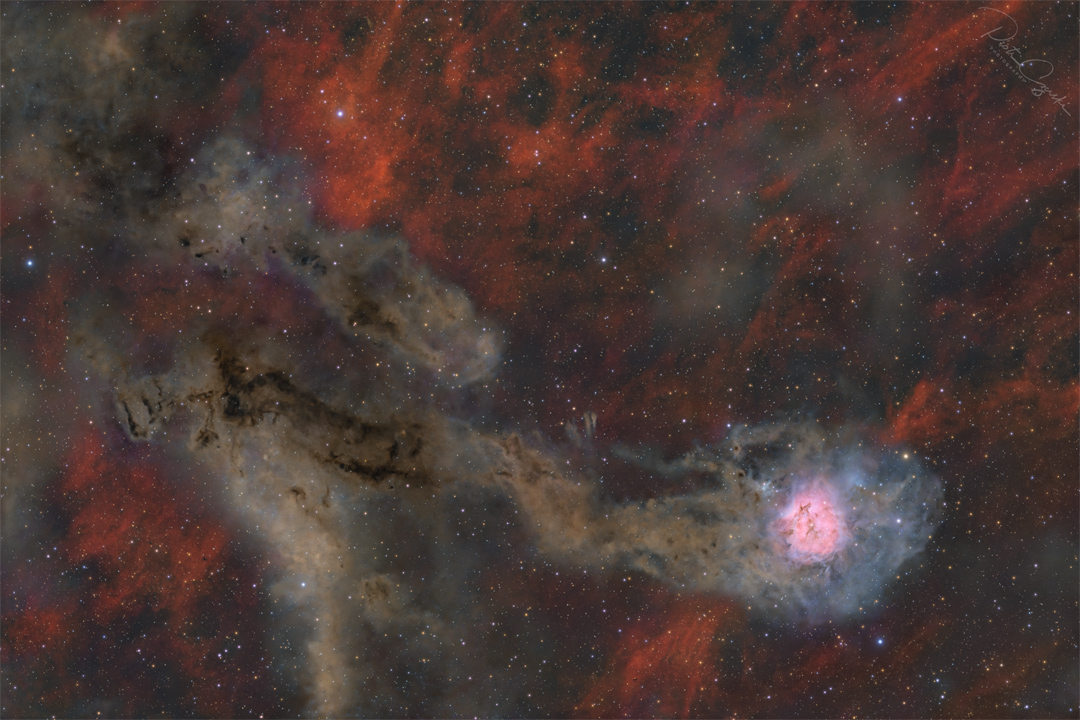
An image published by NASA showcases the Cocoon Nebula (IC 5146) in the constellation Cygnus, captured from Death Valley, California. Located roughly 2,500 light-years from Earth, the complex features a bright central head spanning about 10 light-years and an interstellar dust tail extending nearly 100 light-years, where new stars are forming.
Another featured view captures a solar analemma over the Callanish Stones in the Outer Hebrides of Scotland. Assembled from photographs taken at noon every few days over a full year, the resulting figure-eight path illustrates the combined effects of Earth's axial tilt and elliptical orbit around the Sun as the equinox approaches.
From the Hanle Dark Sky Reserve in Ladakh, India, an astrophotograph records the faint glow of zodiacal light, or false dawn. According to NASA, detections of interplanetary dust by the Juno spacecraft suggest that Mars, visible in the sky alongside Jupiter and star cluster M44, may be the source of dust backscattering sunlight.
NASA's EONET natural event tracking network reported Typhoon Dujuan. According to data from the Joint Typhoon Warning Center (JTWC), the storm was recorded carrying sustained winds of 70 knots.
Sources: NASA APOD, NASA APOD, NASA APOD, NASA EONET
Generated automatically by the Tevel desk and labelled as such.