A Fresh Crater on the Moon and a Black Hole in Omega Centauri
A NASA orbiter spots a new lunar crater, Hubble finds black hole hints in a giant cluster, and satellites track Hurricane Polo.
According to NASA, the Lunar Reconnaissance Orbiter (LRO) detected a new impact crater on the lunar surface, named McGetchin. The crater, measuring two soccer fields across, was formed when an asteroid or comet roughly 10 to 20 meters in size struck the Moon between April and May of 2024. Thermal imaging revealed a cold spot surrounding the crater, where disturbed lunar regolith lost its ability to retain heat.
An image released by NASA, captured at the Oukaïmeden Observatory in Morocco, reveals the remnants of five supernovas in the constellation Auriga. Covering a patch of sky equivalent to one thousand full moons, these structures formed from ancient stellar explosions up to several thousands of light-years away from Earth. The image highlights delicate filaments of shocked hydrogen and oxygen gas expanding into space.
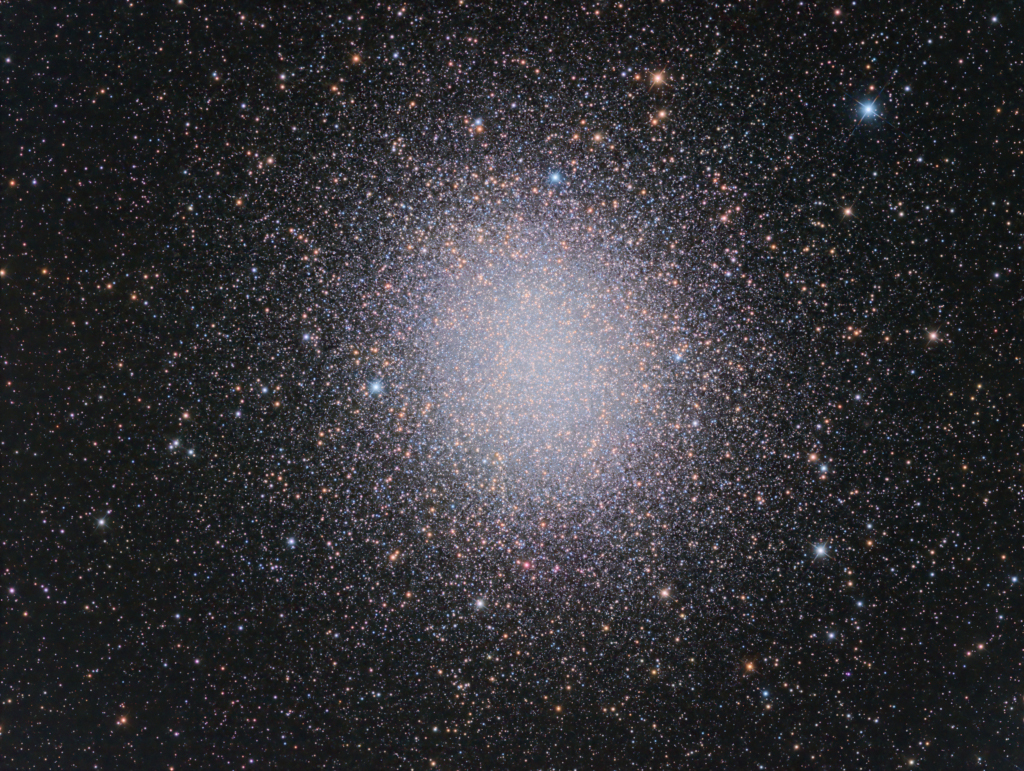
The globular star cluster Omega Centauri (NGC 5139) holds about 10 million stars within a diameter of 150 light-years, located 15,000 light-years away. According to NASA, a two-decade investigation using the Hubble Space Telescope found evidence of a massive black hole at the center of the cluster, which may be the remnant core of a small galaxy that merged with the Milky Way.
According to NASA satellite data, Earth observation systems are tracking multiple severe storms across the globe. Hurricane Polo reached winds of 130 knots, while Hurricane Odalys was measured at 90 knots. Orbiting sensors also monitored Tropical Storm Nolo at 60 knots, Tropical Storm Surigae at 40 knots, and both Tropical Storm Fay and Tropical Cyclone 01B at 35 knots.
Sources: NASA APOD, NASA APOD, NASA APOD, NASA EONET
Generated automatically by the Tevel desk and labelled as such.